Luffing in Sailing: What It Means and Why It Matters
If you are new to sailing, one of the first terms you will hear on the water is luffing. Understanding luffing in sailing is important because it directly affects how a boat moves, how well the sails work, and how much control the helmsman has. Whether you are learning basic sail trim or trying to improve boat handling, knowing what luffing means will help you become a more confident and capable sailor.
What Is Luffing in Sailing?
Luffing in sailing happens when a boat is steered too close to the wind, or when the sails are trimmed in a way that breaks smooth airflow across the sail. Luffing refers to the condition where the sail's forward edge flutters or collapses due to improper wind flow, often occurring when sailing into the wind or adjusting sails to control speed. In sailing, the definition of luffing is also outlined in the rulebook to help sailors interpret and apply the rules accurately.
When that happens, the sail stops producing efficient aerodynamic lift and begins to flap, shake, or flutter. This is often most visible along the luff, which is the forward edge of the sail that first meets the wind.
A good beginner way to think about luffing is this: the sail is no longer drawing properly. Instead of pulling the boat forward, it starts acting more like a flag blowing in the wind. The result is noise, vibration, loss of power, and reduced efficiency. The direction of the wind plays a key role in when luffing occurs. Steering closer to the wind or changing course relative to the wind can cause the sail to luff.
Why Luffing Happens
Luffing usually happens for one of two main reasons.
The first is that the helmsman turns the bow too far toward the wind. Every sailboat has an upwind limit, often called the close-hauled point of sail. When the boat is pushed past that angle, the sails cannot maintain attached airflow, so they begin to luff.
The second is poor sail trim. If the sails are eased too far out for the boat's heading, the wind will not flow evenly over the sail surface. That breaks the sail's shape and causes flutter at the front edge. Luffing can also occur when the sail is adjusted past optimal trim, meaning the sail is positioned beyond the ideal point for efficient airflow. Achieving optimal trim is essential for maximizing sailing performance and efficiency.
In simple terms, luffing in sailing is a sign that the boat's heading and sail trim are no longer working together. To correct luffing, sailors often use sheet control, easing or trimming the sheets to restore proper sail shape and regain efficient airflow.
Luffing can also be influenced by existing conditions such as sudden wind shifts or changes in sea state, which may require quick adjustments to maintain control.
What Luffing Looks and Feels Like on the Water
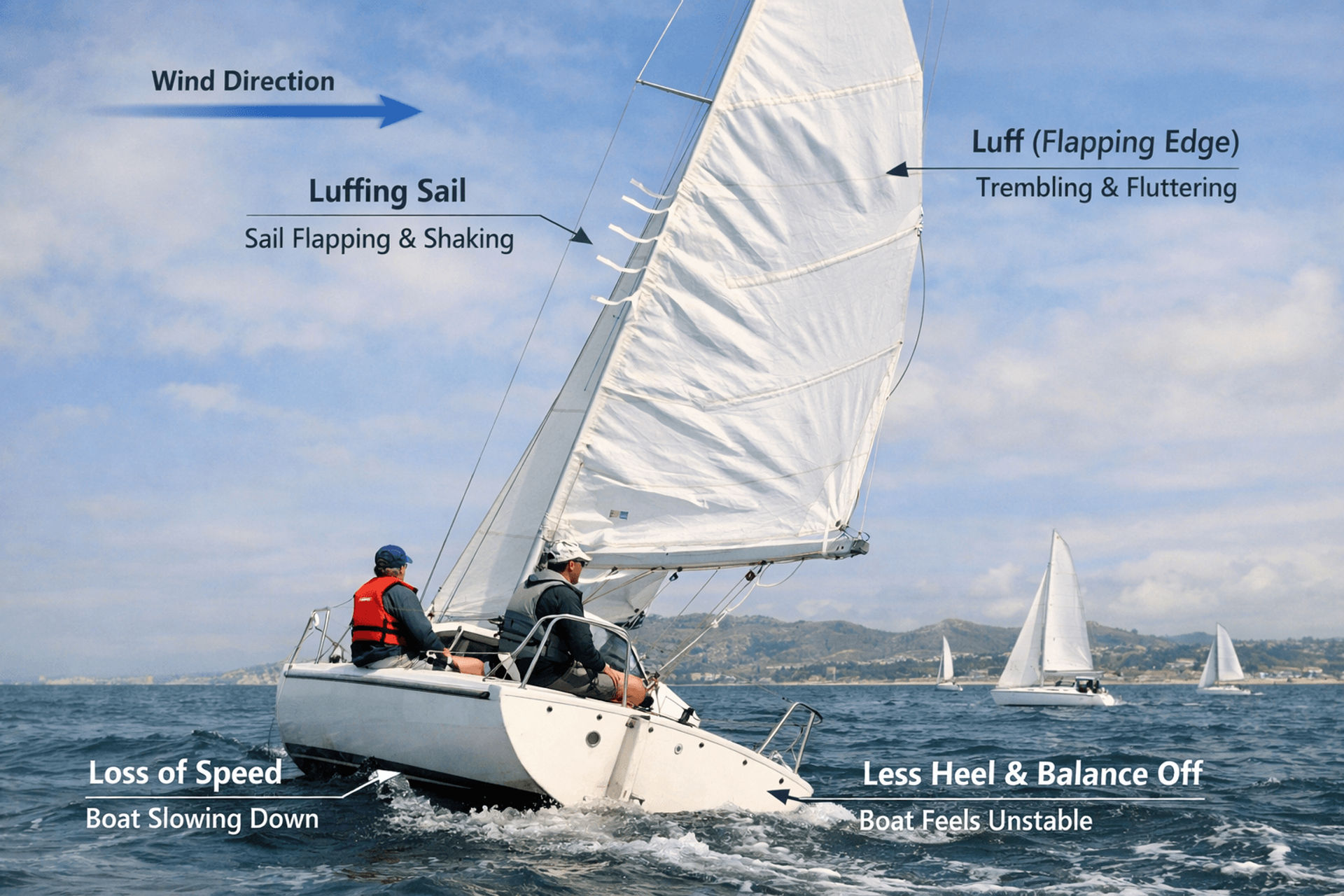
For beginners, luffing is often easiest to recognize by sight and sound. Luffing occurs when the front edge of the sail starts to tremble. Then the sail may flap loudly, lose its clean shape, and stop pulling efficiently. The boat may slow noticeably, heel less, and feel less balanced.
This feedback is actually useful. There is a critical moment when luffing is first detected, and that signals the need for immediate adjustment. Sailors often use the first small signs of luffing as a cue to make corrections. The boat's position relative to the wind can make luffing more or less likely. A slight flutter at the luff can tell you that you are right on the edge of proper trim, especially when sailing upwind. That is why learning to read luffing is such an important part of sail awareness.
How Luffing Affects Sail Trim
Sail trim is all about managing the angle and shape of the sails so they work efficiently with the wind. Because of that, luffing plays a major role in sail trim decisions.
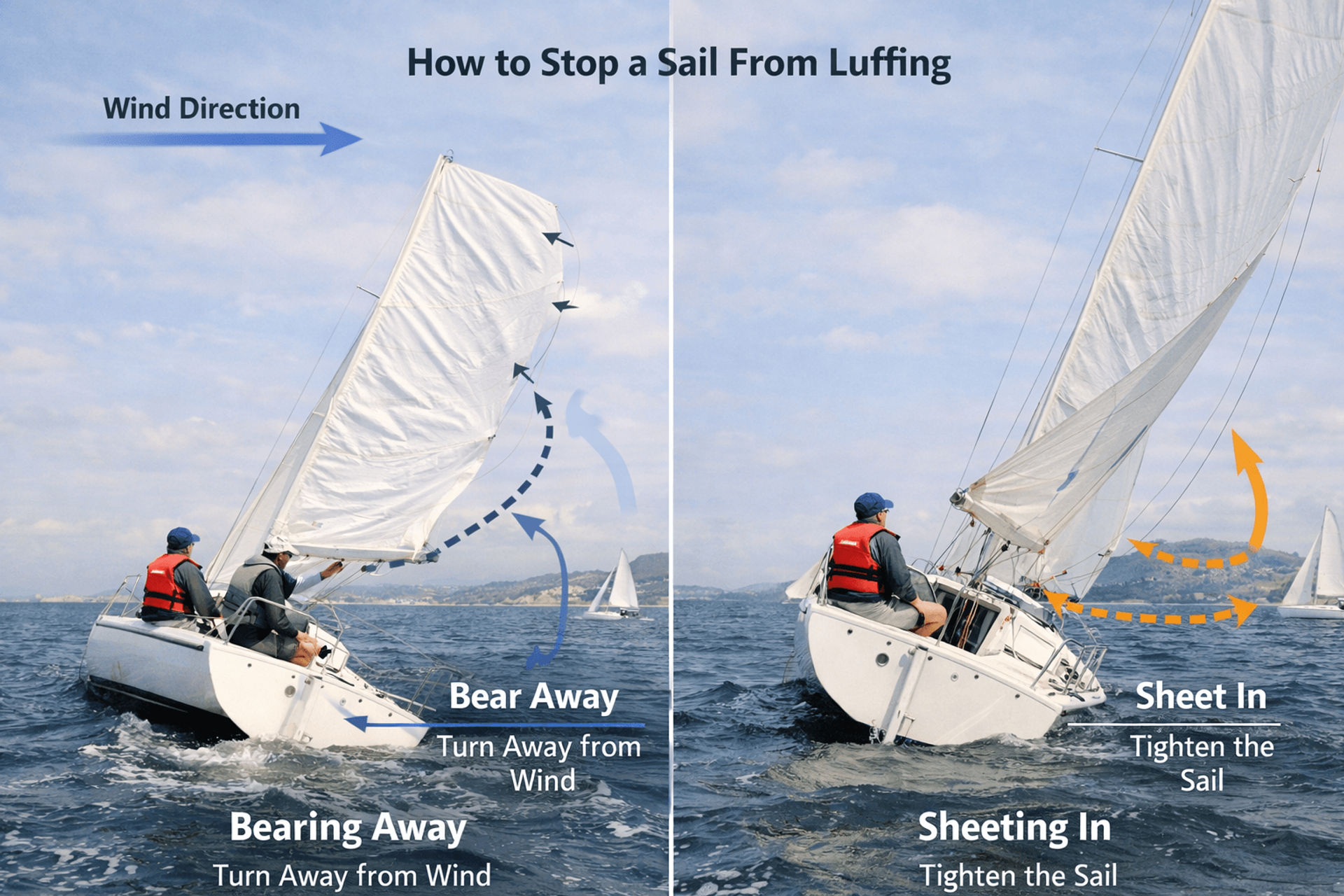
When a sail luffs, it means the trim is off for the current course and wind angle. To correct it, a sailor will usually do one of two things: bear away slightly, which means turning away from the wind, or sheet in, which means trimming the sail tighter. Adjusting boom position can also help achieve optimal trim by controlling the sail's shape and angle relative to the wind. Either change can restore airflow and bring the sail back to life.
Changes in the direction of the wind require constant adjustments to the sails to maintain proper sail shape and efficient airflow. If the sail is trimmed past optimal trim, luffing or a loss of power can result, often indicated by fluttering at the luff or a stalled sail.
This is one reason instructors spend so much time teaching students how to watch the front of the sail. The luff gives immediate feedback. If it is fluttering, the sail is underpowered. If it is drawing cleanly, the trim is likely much closer to correct.
Why Luffing Matters for Boat Control
Luffing in sailing is not just about sail shape. It is also a major part of boat control, and the skipper plays a key role in using luffing to manage the sailing vessel's speed and direction.
A sailor can use luffing intentionally to reduce power fast. For example, when approaching a dock, navigating in tight quarters, or reacting to a sudden gust, turning slightly into the wind can make the sails luff and quickly slow the boat down.
Luffing is also a technique used before the start of a race or when approaching a dock to avoid crossing the starting line too early. In these situations, maneuvering promptly and in a seamanlike way is essential to maintain control and comply with racing rules. In stronger conditions, sailors may also feather into the wind to partially luff the sails and keep the boat more upright and manageable.
Luffing is also part of several core maneuvers. During a tack, the bow of the sailing vessel passes through the wind and the sails luff briefly as they cross the no-go zone before filling on the new side. If a sailing vessel turns too far into the wind and loses all forward momentum, it can end up in irons, stalled with the bow pointed directly into the wind.
So while accidental luffing can hurt performance, controlled luffing can be a smart tool for safe handling.
Luffing and Sailing Performance
From a performance standpoint, too much luffing usually means lost speed. Since a luffing sail is no longer generating efficient lift, the boat slows down and becomes less effective on its course. That matters whether you are day sailing, practicing maneuvers, or trying to sail efficiently upwind.
At the same time, skilled sailors sometimes use slight luffing as a precision tool. Sailing very close to the wind often involves balancing right on the edge of luffing without crossing into it for too long. That balance helps maximize upwind angle while still keeping the sails powered.
In racing, luffing can even become tactical. A leeward boat may luff a windward boat to force them higher and disrupt their course. For beginners, though, the main lesson is simpler: uncontrolled luffing usually means the boat is giving away speed and control.
How to Stop a Sail From Luffing
When a sail begins luffing, the fix is usually straightforward once you know what to watch for.
If the boat is pointed too high, bear away slightly so the wind meets the sail at a better angle. If the sail is too loose for the course, sheet in until the flutter stops and the sail fills properly again.
Adjusting the jib track car can also help reduce luffing by increasing downward tension on the sail's edge, making the sail shape more stable.
On a windy day, luffing may occur more easily and require more frequent adjustments to keep the sails trimmed correctly.
Over time, sailors learn to make these adjustments almost automatically. They notice the first small flutter at the luff, respond with a small steering or trim change, and keep the boat balanced and moving efficiently.
What Holding Your Luff Means
You may also hear the phrase holding your luff. This means maintaining a very steady course as close to the wind as possible without letting the sails flap. It is an important skill because it requires the helmsman and crew to work together with precision. Small steering changes and small trim adjustments can make a big difference.
For beginners, this is one of the clearest ways to understand the relationship between wind angle, sail trim, and boat speed. When you can hold the boat right at the edge of luffing, just before reaching the head-to-wind position without losing power, you are starting to develop real feel for the boat.
Why Beginners Should Learn About Luffing Early
Few sailing concepts teach more, faster, than luffing. It shows you when the sails are no longer working efficiently. It teaches you how steering and trim affect one another. It helps you understand upwind sailing, tacking, depowering, and recovery from mistakes. Learning the word luffing, and other key sailing vocabulary, helps beginners grasp important concepts and communicate more effectively on the water.
Most importantly, learning luffing in sailing gives beginners a clearer sense of cause and effect on the water. Turn too high, and the sail flaps. Ease too much, and the sail loses shape. Correct the course or trim, and the boat comes back to life. That kind of direct feedback makes luffing one of the best teaching tools in sailing.
Learn Luffing and Sail Trim With Naos Yachts in Marina del Rey
At Naos Yachts in Marina del Rey, we offer sailing instruction for beginners and experienced boaters who want to build more confidence on the water. Through our sailing school, students can take a variety of American Sailing and American Boating certified classes designed to help them improve their skills in a practical, hands-on setting.
If you want to better understand luffing, sail trim, and boat control, our American Sailing 102 Keelboat Sailing class is a great next step. In this course, you can get real experience with sail handling, steering technique, tacking and jibing, points of sail, docking, and learning how the boat responds to changing wind conditions.
Take the Next Step in Your Sailing Journey
Luffing in sailing is more than just a flapping sail. It is one of the clearest signals a sailor gets about sail trim, course angle, and boat balance. When you understand why luffing happens and how to respond to it, you improve your control, protect performance, and build stronger sailing instincts.
If you are ready to learn more about luffing, sail trim, and practical boat handling, contact Naos Yachts today or book a class directly online. Their sailing school offers a wide range of American Sailing and American Boating certified classes, and their American Sailing 102 Keelboat Sailing course is a great way to build real-world confidence on the water.
FAQs
What does luffing mean in sailing?
Luffing in sailing is the condition when the forward edge (luff) of the sail loses proper airflow due to wind angle. This typically happens when a boat turns too close to the wind or when the sails are trimmed incorrectly, causing the sails to lose power and begin to flap. It is a common sign that the sail is no longer drawing efficiently.
What is the difference between luff and luffing?
The luff is the forward edge (or leading edge) of a sail, the part that meets the wind first. Luffing refers to the action or condition when this edge begins to flap or flutter because it is not catching the wind correctly. In other words, the luff is part of the sail, while luffing is a sailing condition.
Why do sails luff?
Sails luff when airflow over the sail breaks down, often because they are not at optimal trim or have been adjusted past optimal trim. This can occur if the boat is pointed too far into the wind or if the sail has been eased too far out for the current course. Adjusting the sheets to trim or ease the sails helps restore proper airflow and maintain efficient sailing performance.
Is luffing in sailing bad?
Luffing is not always bad, but uncontrolled luffing usually reduces speed and performance. Sailors also use luffing intentionally to slow down, reduce power, or help manage the boat in stronger wind.
Can luffing damage sails?
Occasional brief luffing is a normal part of sailing, especially during maneuvers. However, excessive luffing, when the sail flaps heavily and repeatedly for extended periods, can strain sailcloth and stitching and lead to premature wear. This is one reason proper trim matters.