How to Navigate by Ocean Stars: A Beginner's Guide to Celestial Navigation

Long before GPS, chartplotters, radar, and smartphone apps, sailors crossed oceans by watching the sky. They learned how to navigate by ocean stars by observing where stars rose and set, measuring their height above the horizon, and using familiar constellations to stay oriented at sea. For new sailors, celestial navigation can feel mysterious at first, but the basic ideas are surprisingly approachable.
This beginner's guide explains how to navigate by the stars using simple, practical concepts. You will learn how sailors use Polaris, the Southern Cross, star paths, the horizon, and sextants to find direction, estimate latitude, and build confidence when modern electronics are not available.
What Does Navigating by the Stars Mean?
Navigating by the stars is the practice of using celestial bodies to determine direction, position, or course while traveling. At sea, this usually means observing stars in relation to the ocean horizon. Because the horizon is open and visible in every direction, sailors can use the sky like a natural compass.
When sailors talk about how to navigate by ocean stars, they are usually focused on three core skills:
- Finding true north or true south
- Estimating latitude by measuring a star's altitude
- Maintaining a heading by following the rising or setting points of stars
Celestial navigation can be practiced with the naked eye, but precise offshore navigation often involves a sextant, a nautical almanac, accurate timekeeping, and navigation tables.
Why Learning How to Navigate by Ocean Stars Still Matters
Modern sailors have access to powerful electronic navigation tools, but those systems depend on batteries, antennas, satellites, software, and working instruments. Celestial navigation gives sailors another layer of awareness and self-reliance.
Learning how to navigate by the stars can help you:
- Understand direction without relying only on electronics
- Build a deeper relationship with the ocean, horizon, and night sky
- Improve traditional seamanship skills
- Prepare for offshore passages where redundancy matters
- Gain confidence when sailing at night or beyond familiar waters
Even if you never cross an ocean using only celestial navigation, the skill teaches you how sailors think: observe carefully, verify your position, and never depend on one source of information alone.
The Basic Idea Behind How to Navigate by the Stars
Stars appear to move across the sky because Earth rotates. Most stars rise in the east, travel across the sky, and set in the west. Some stars and constellations are especially useful because their position helps sailors identify direction or estimate location.
The key reference points are:
- The horizon: The line where the ocean appears to meet the sky
- Altitude: The angle of a star above the horizon
- Azimuth: The direction of a star along the horizon
- True north and true south: Fixed directions used for navigation
- Latitude: Your distance north or south of the equator
For beginners, the easiest place to start is with direction. Once you can identify north or south, you can begin to understand how stars can help you maintain a course.
How to Navigate by Ocean Stars in the Northern Hemisphere Using Polaris
In the Northern Hemisphere, Polaris, also known as the North Star, is one of the most important celestial navigation references. Polaris sits very close to the north celestial pole, which means it appears almost fixed in the sky while other stars rotate around it.
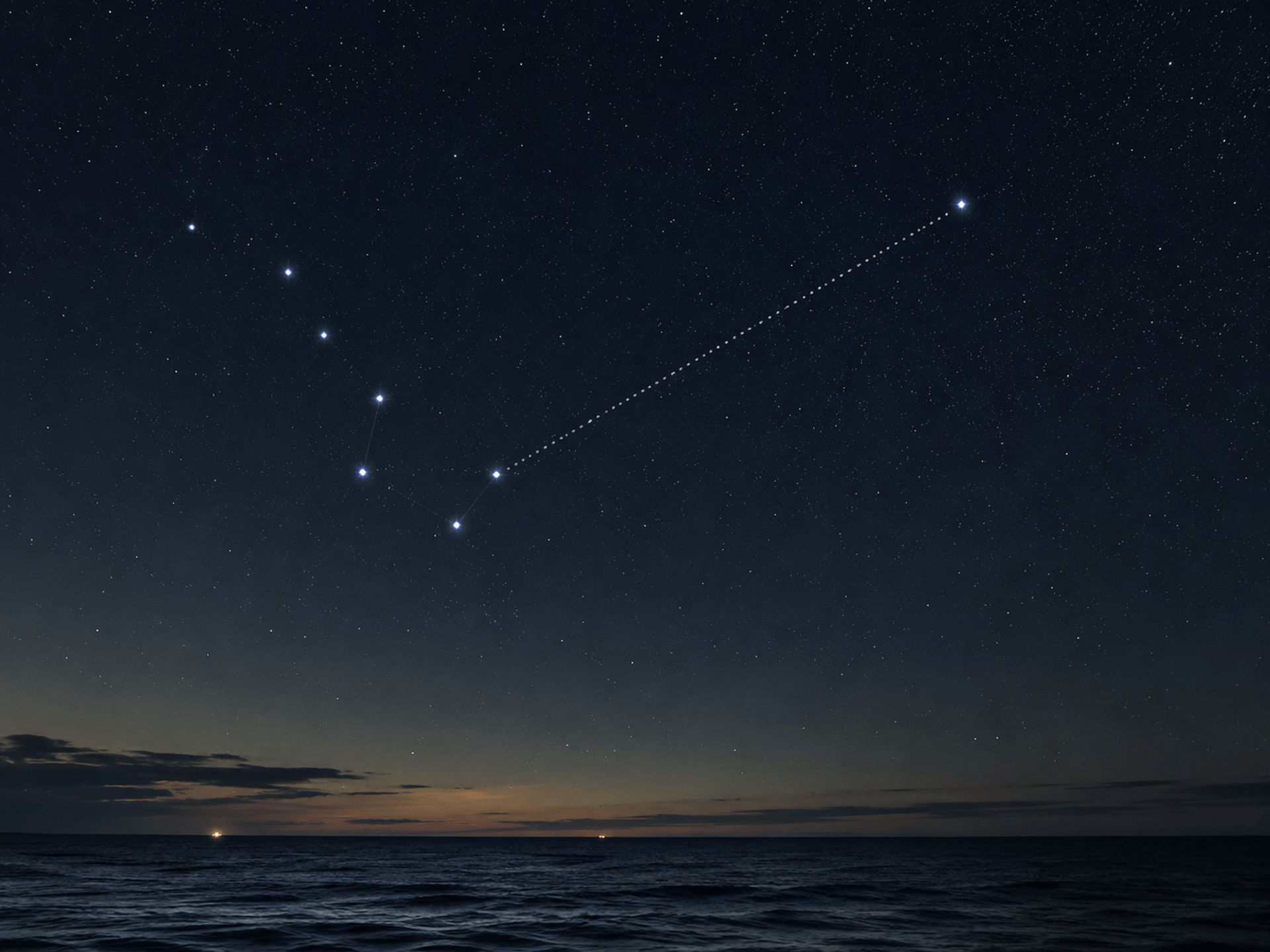
Because Polaris marks true north, it helps sailors orient themselves at night.
How to Find Polaris With the Big Dipper
One of the easiest ways to locate Polaris is by using the Big Dipper:
- Find the Big Dipper's bowl shape in the northern sky.
- Locate the two stars on the outer edge of the bowl.
- Draw an imaginary line through those two "pointer stars."
- Extend that line about five times the distance between them.
- The bright star you reach is Polaris.
Once you find Polaris, face it. You are facing true north. South is behind you, east is to your right, and west is to your left.
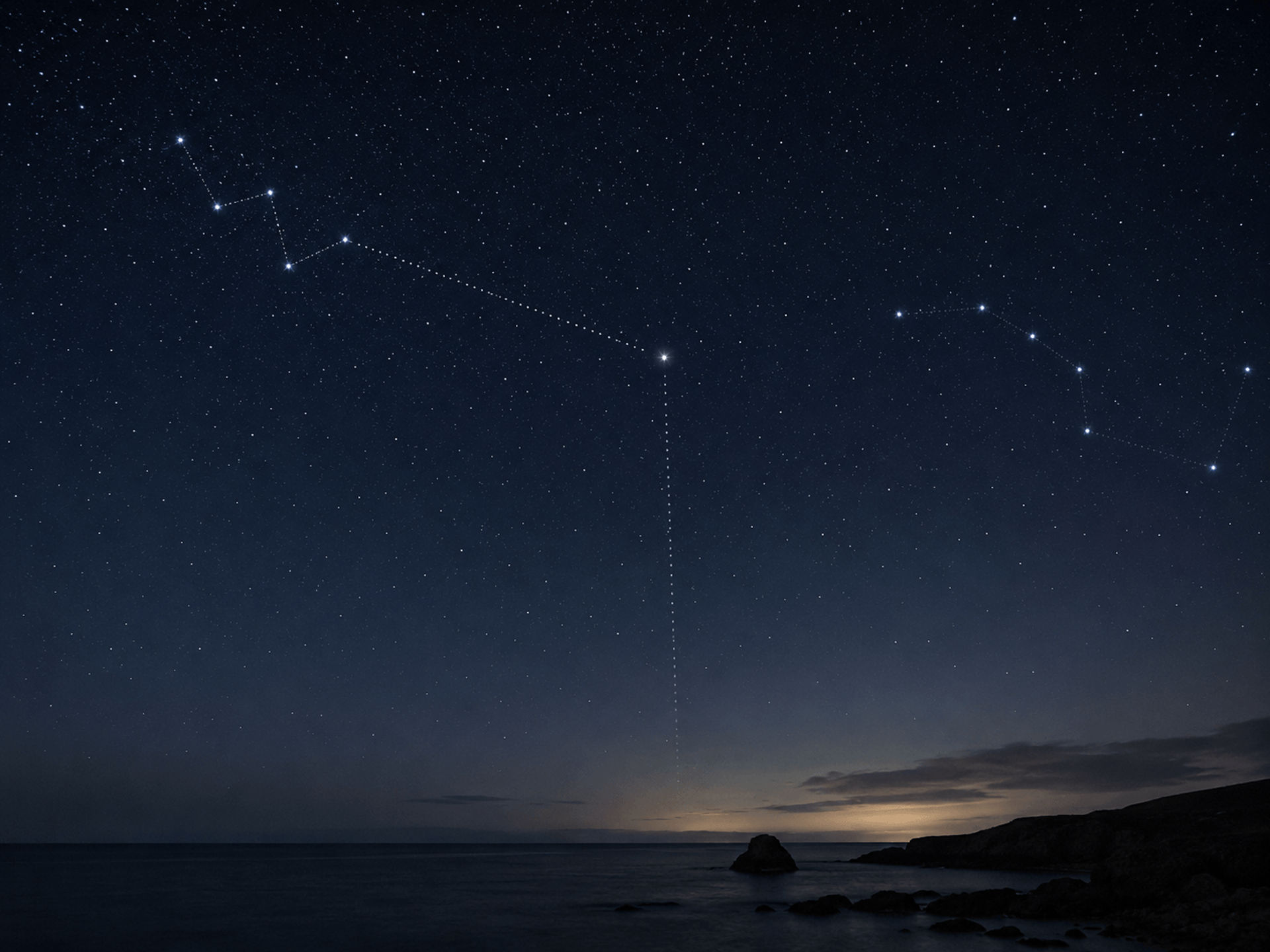
How to Find Polaris With Cassiopeia
If the Big Dipper is low or hidden, look for Cassiopeia. This constellation has a distinctive "W" shape.
To use Cassiopeia:
- Find the wide "W" in the northern sky.
- Look from the center of the wider "V" shape.
- Follow an imaginary line outward toward the area opposite the Big Dipper.
- Use that line to help identify Polaris.
The Big Dipper and Cassiopeia sit on opposite sides of Polaris, so one may be easier to see depending on the time of night and season.
Using Polaris to Estimate Latitude
One of the most useful beginner concepts in celestial navigation is this: in the Northern Hemisphere, the altitude of Polaris above the horizon is approximately equal to your latitude.
For example:
- If Polaris is about 34 degrees above the horizon, you are near 34 degrees north latitude.
- If Polaris is about 20 degrees above the horizon, you are near 20 degrees north latitude.
- If Polaris is close to the horizon, you are closer to the equator.
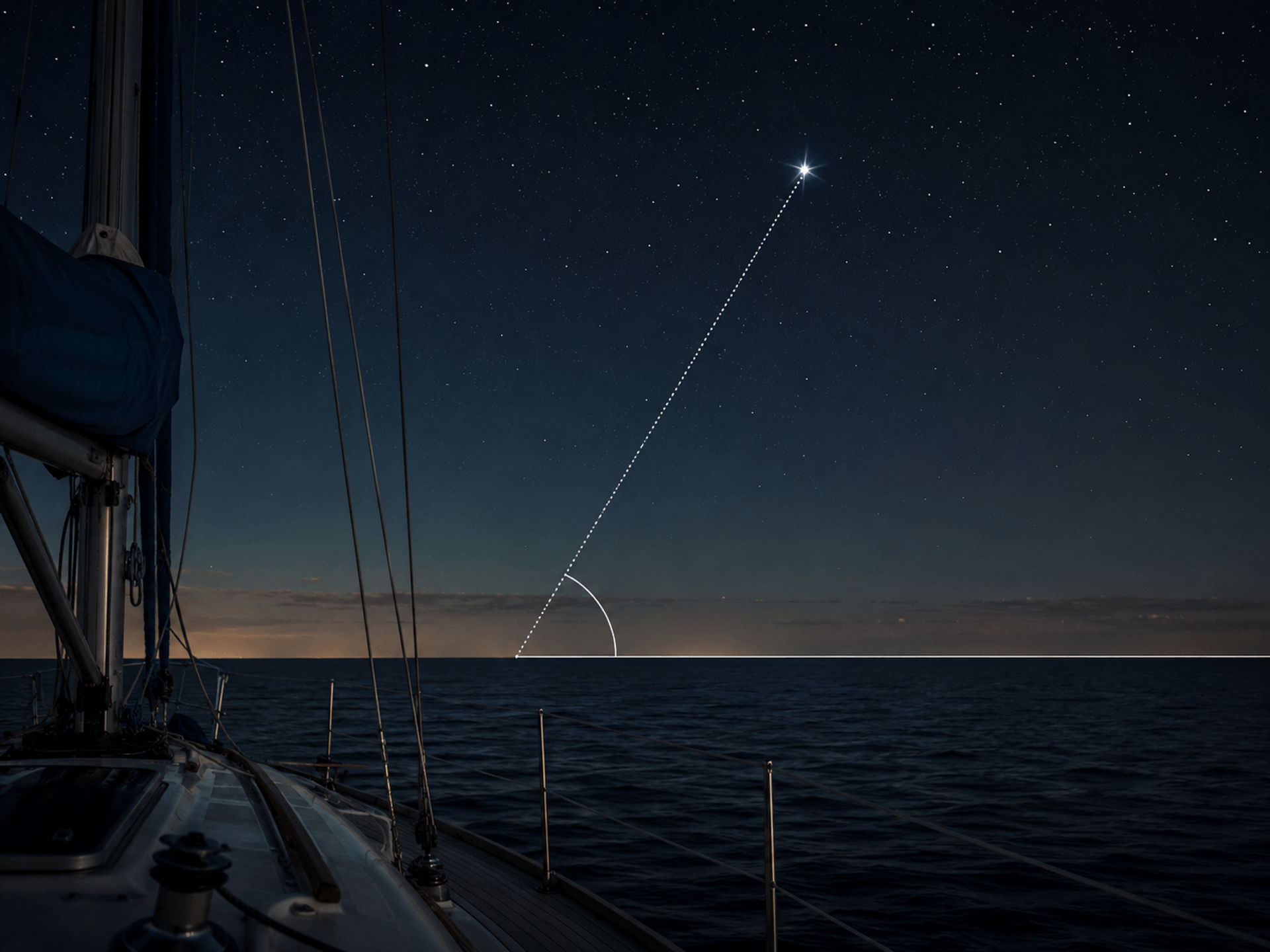
You can estimate this angle by eye, but sailors use tools for better accuracy. A sextant provides a much more precise measurement by allowing you to bring the image of the star down to the horizon and read its altitude.
This is one reason Polaris is so valuable. It gives sailors both a direction reference and a rough latitude reference.
How to Navigate by the Stars in the Southern Hemisphere
The Southern Hemisphere does not have a bright equivalent of Polaris directly over the south celestial pole. Instead, sailors commonly use the Southern Cross, also called Crux, to locate true south.
The Southern Cross is a small but distinctive constellation shaped like a kite or cross. Its long axis points toward the south celestial pole.
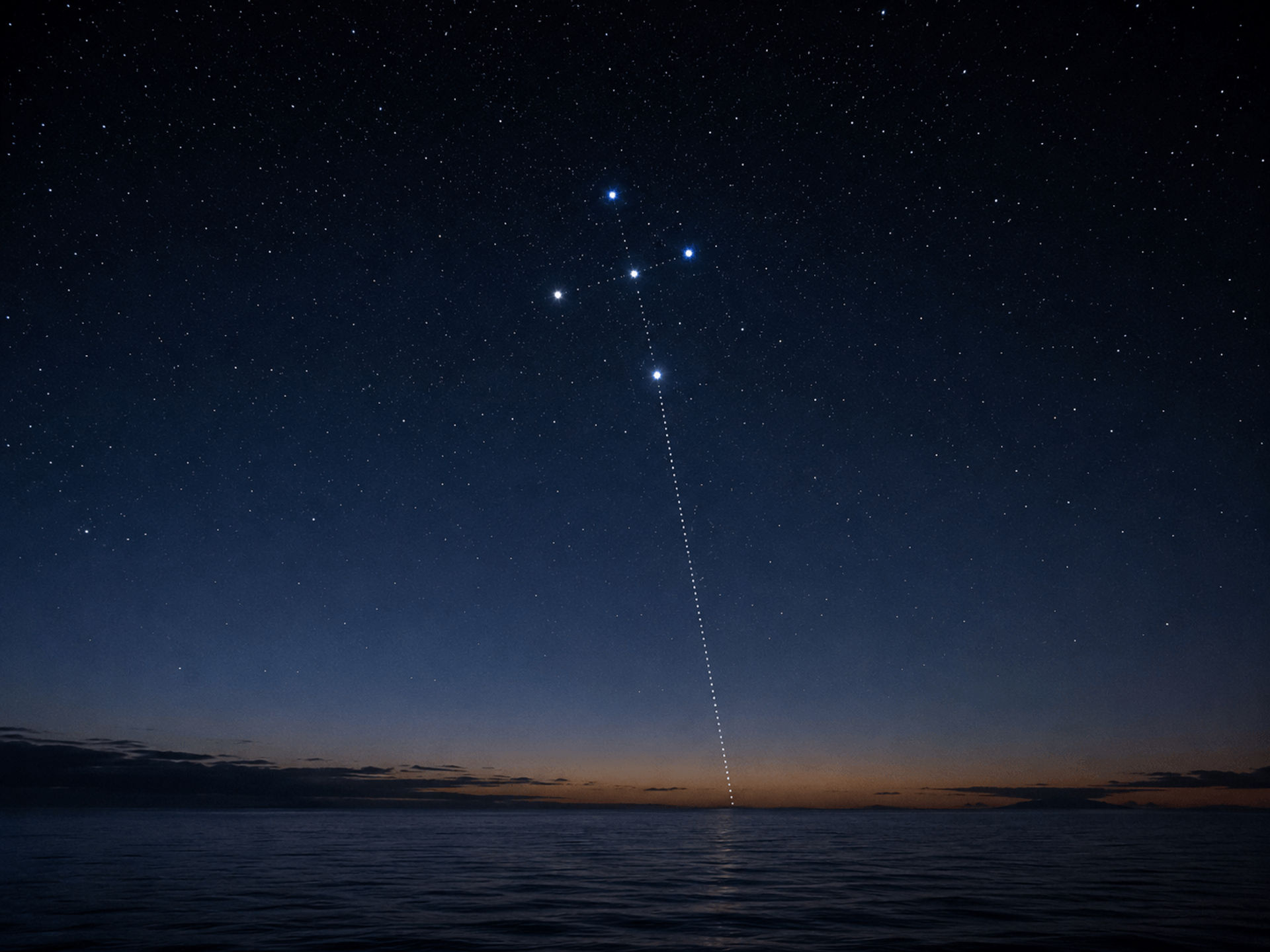
How to Find True South With the Southern Cross
To use the Southern Cross:
- Locate the cross or kite shape of Crux.
- Identify the long axis running from Gacrux at the top to Acrux at the bottom.
- Extend an imaginary line from Gacrux through Acrux.
- Continue that line several times the length of the cross.
- Drop a line from that point down to the horizon.
The point where that imaginary line meets the horizon is approximately true south. Once you know south, north is behind you, east is to your left, and west is to your right.
This method takes practice because nearby stars can be mistaken for the Southern Cross. Beginners should study star charts or use instruction from an experienced navigator before relying on this technique offshore.
Navigating by the Stars With Star Paths
Not all celestial navigation is about finding one fixed star. Traditional ocean navigators, including Polynesian voyagers, used a broader system of star paths. Instead of relying only on Polaris or the Southern Cross, they memorized where many stars rose and set along the horizon.
This method works because stars rise and set at predictable points. A sailor can steer toward a star as it rises or sets, then switch to another star along the same path as the first star climbs higher or disappears.
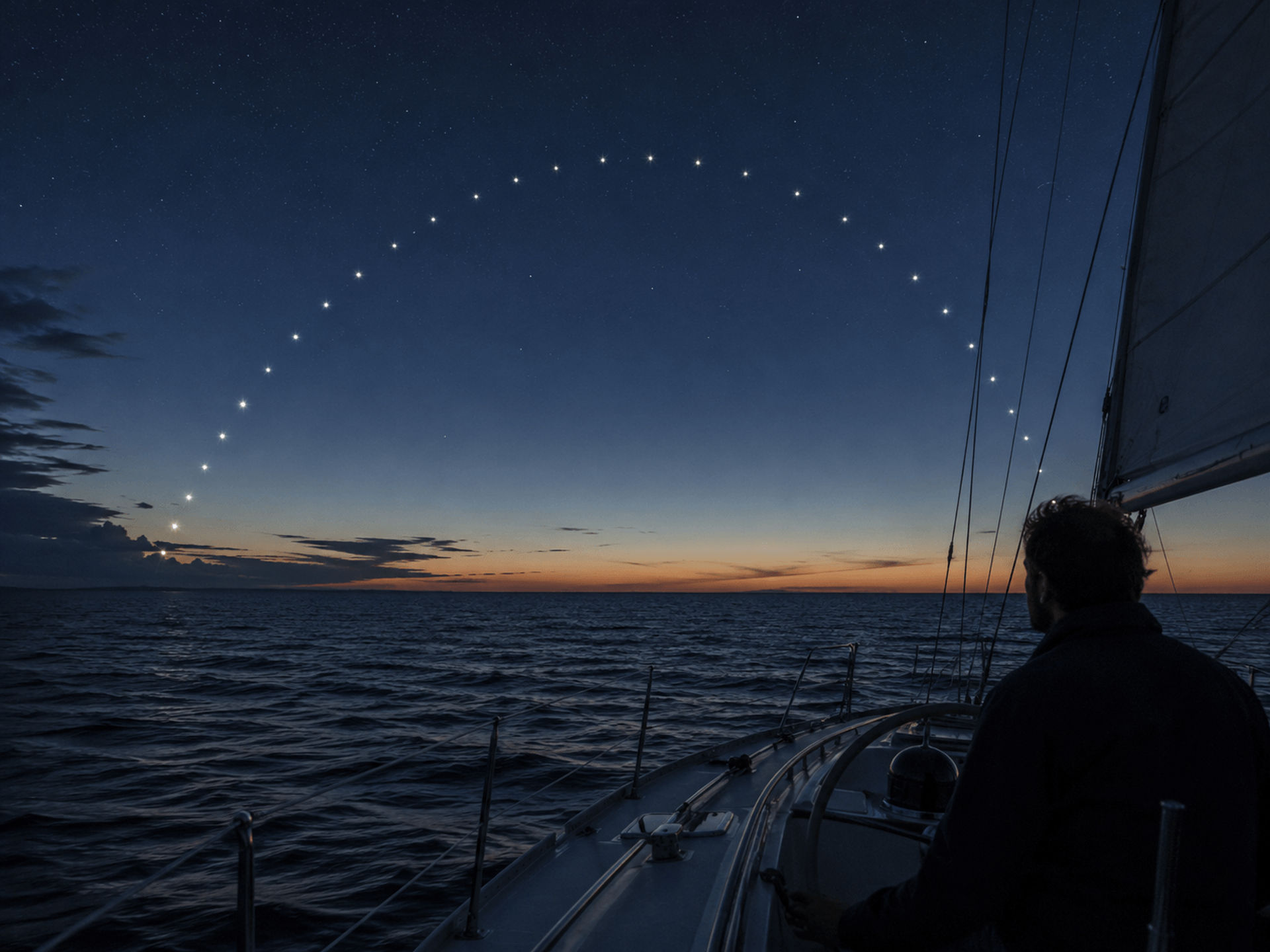
How Star Path Navigation Works
A simplified version looks like this:
- Choose a star that rises or sets in the direction you want to travel.
- Keep the boat aligned with that star as a steering reference.
- When the star moves too high in the sky or sets, shift to another star on the same route.
- Continue using a sequence of stars to maintain a steady heading.
This kind of wayfinding requires memory, practice, and constant observation. It also teaches sailors to pay attention to wind, swell, clouds, birds, current, and the feel of the boat. The stars are one part of a larger natural navigation system.
Understanding East, West, and the Movement of Stars
As a beginner, one of the simplest celestial navigation tips is to watch the direction stars appear to move.
In general:
- Stars rise in the east.
- Stars set in the west.
- In the Northern Hemisphere, stars appear to rotate around Polaris.
- In the Southern Hemisphere, stars appear to rotate around the south celestial pole.
This movement can help you stay oriented when you are sailing at night. If you are unsure of direction, observe a star for several minutes. Its movement will help you identify east and west, while Polaris or the Southern Cross can help you confirm north or south.
How Sailors Use a Sextant for Precision
For serious celestial navigation, sailors use a navigational sextant. A sextant is an optical instrument that measures the angle between a celestial body and the horizon.
The basic process is:
- Select a star, planet, the sun, or the moon.
- Look through the sextant toward the horizon.
- Adjust the sextant until the reflected image of the celestial body touches the horizon.
- Record the measured altitude.
- Record the exact time of the observation.
- Use a nautical almanac and sight reduction tables to calculate a line of position.
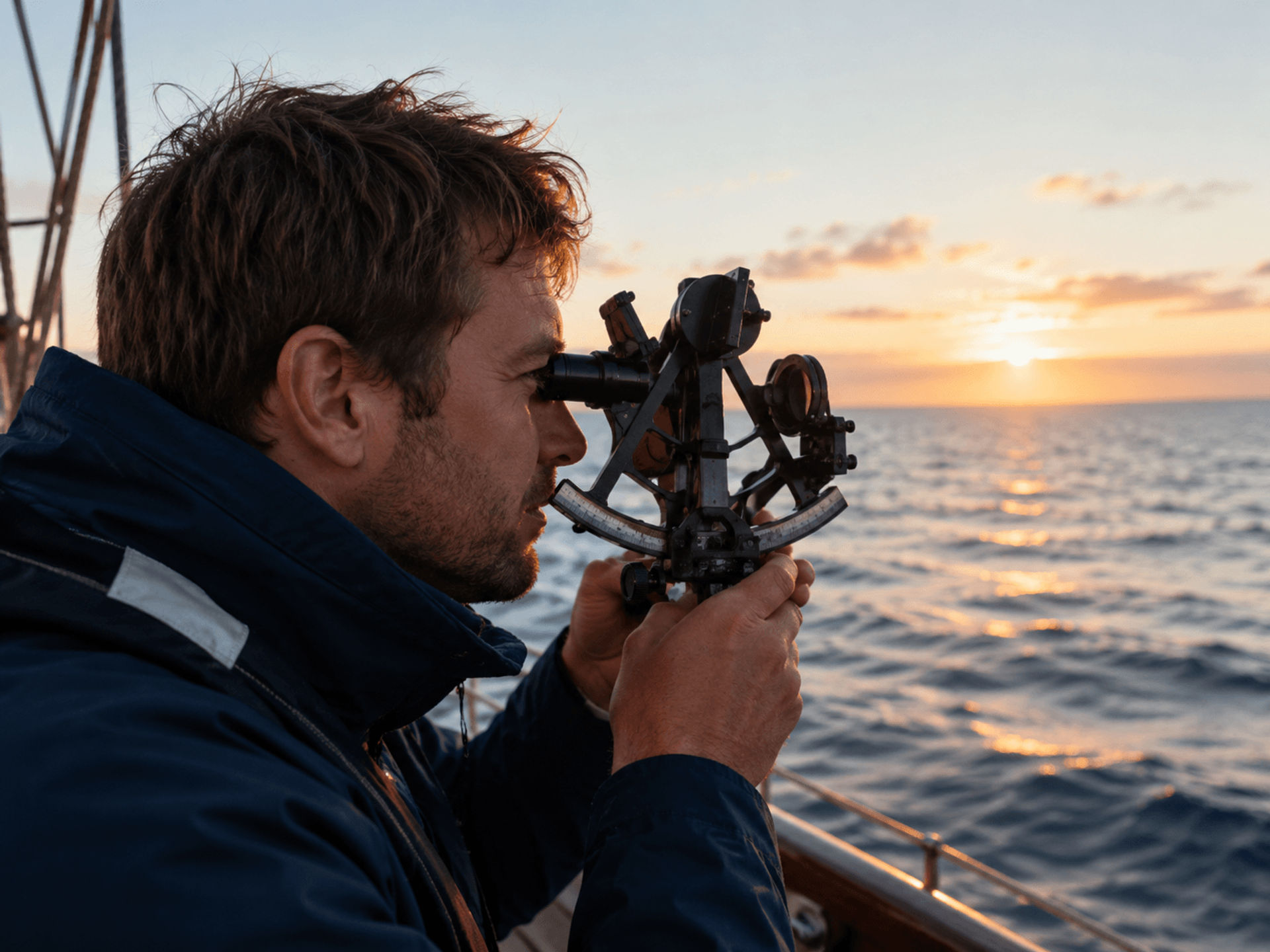
With enough observations, a navigator can determine a position fix. This is more advanced than simply finding north with Polaris, but it is the foundation of traditional offshore celestial navigation.
Beginner Tips for How to Navigate by Ocean Stars
If you are new to navigating by the stars, start with observation before calculation. The more familiar the night sky becomes, the easier the technical side of navigation will feel.
Use these beginner tips:
- Practice from shore first. Go to a dark location with a clear view of the horizon.
- Learn one constellation at a time. Start with the Big Dipper, Cassiopeia, Polaris, or the Southern Cross depending on your hemisphere.
- Use a star chart or navigation app for learning only. Train your eye, but do not become dependent on the screen.
- Watch the sky for movement. Notice which stars rise, set, or circle around the celestial pole.
- Estimate angles with your hand. An outstretched fist is roughly 10 degrees wide for many people.
- Keep a notebook. Record what you see, the time, direction, and your estimated altitude.
- Take a formal navigation class. A structured course helps connect sky observations with charts, plotting, compass work, and safe seamanship.
Common Mistakes Beginners Make When Navigating by the Stars
Celestial navigation rewards patience and accuracy. Beginners often run into problems because they rush or rely on assumptions.
Common mistakes include:
- Confusing magnetic north with true north
- Mistaking another bright star for Polaris
- Trying to learn too many constellations at once
- Forgetting that clouds, haze, and light pollution affect visibility
- Measuring altitude from an uneven or unclear horizon
- Recording the wrong time for a sextant sight
- Treating celestial navigation as a replacement for charts, weather awareness, and seamanship
The goal is not to memorize the entire sky overnight. The goal is to build reliable habits: observe, verify, record, and cross-check.
Learn Navigating by the Stars at Naos Yachts in Marina del Rey
At Naos Yachts in Marina del Rey, we help sailors build real confidence on the water through practical instruction, modern boats, and a wide range of American Sailing and American Boating certified classes. Whether you are taking your first sailing course, preparing for coastal cruising, or looking to sharpen advanced seamanship skills, our sailing school is designed to help you progress with clear instruction and hands-on experience.
For sailors who want to go beyond basic boat handling, our American Sailing 105 Coastal Navigation class is an excellent next step. ASA 105 focuses on the essential navigation skills that every serious sailor should understand, including chart reading, course plotting, position awareness, tides, currents, and traditional navigation principles. It is also a valuable course for anyone interested in how to navigate by ocean stars, navigating by the stars, and learning how celestial navigation connects with real-world coastal passagemaking.

Book a Sailing Class at Naos Yachts in Marina del Rey Today
Learning how to navigate by ocean stars is more than a historic sailing skill. It is a practical way to become a more observant, capable, and confident sailor. From finding Polaris to understanding star paths and using a sextant, celestial navigation teaches you to read the world around you with greater precision.
If you are ready to build stronger navigation skills, contact us here at Naos Yachts in Marina del Rey or book a class directly online. Our American Sailing and American Boating certified courses can help you take the next step, and our ASA 105 Coastal Navigation class is the perfect place to deepen your understanding of how to navigate by the stars and much more.
FAQs
What is the easiest star to use for navigation?
In the Northern Hemisphere, Polaris, also known as the North Star, is usually the easiest and most useful star for navigation. Because it sits close to true north, sailors can use it to find direction and estimate latitude.
Do you need a sextant to navigate by the stars?
You do not need a sextant for basic orientation, such as finding north or south by using stars. However, a sextant is needed for more precise celestial navigation because it measures the angle between a celestial body and the horizon.
How accurate is navigating by the stars?
Basic star navigation can help sailors estimate direction and latitude, but it is not as precise as GPS. With a sextant, accurate timekeeping, a nautical almanac, and proper calculations, experienced navigators can determine a much more precise position.
What constellations should beginner sailors learn first?
Beginner sailors in the Northern Hemisphere should start with the Big Dipper, Cassiopeia, and Polaris. In the Southern Hemisphere, the Southern Cross is one of the most important constellations to learn for finding true south.