An offer arrives on a Tuesday and the first week feels settled: deposit received, survey booked, haul-out reserved. Then the buyer's broker sends a document request and the file comes up short. A lien release promised verbally in 2019. A registration that lapsed two cycles ago. A co-owner who stopped answering email.
When you are selling a boat in California, paperwork is rarely what breaks a deal. What breaks it is learning in week four that a form was never filed and the fix takes six weeks you do not have. Buyers read that gap as leverage, and moorage keeps billing while they do.
What follows is the audit a private seller can run alone before advertising. Whether to sell alone at all is a separate calculation; the file is the part you control.
First Fork: Coast Guard Documented, or California Titled?
Two systems run in parallel, and a boat sits in one of them. Most owners answer from memory rather than from the record.
A pleasure vessel of at least 5 net tons may be documented with the Coast Guard at the owner's option. CDTFA puts that threshold at roughly 28.5 feet for a typical recreational boat, though net tonnage measures volume, not length. Documentation is required beyond the three-mile limit and for commercial vessels at that tonnage, per CDTFA's vessel guidance. Below it, the boat lives on the state side.
If the listing decision is still open, the Marina del Rey guide covers it.
The Documented-Vessel File: What NVDC Actually Needs
A documented boat carries a Certificate of Documentation and an official number, and the USCG documentation transfer is a federal filing — even when the buyer lives in California. On a change of ownership the new owner files form CG-1258 with evidence of title and, where a lender holds a preferred mortgage, consent on CG-4593. 46 CFR 67.141 sets out those requirements, and the vessel must be marked before the application goes anywhere.

The transfer document is CG-1340, the Bill of Sale, published alongside CG-1258 and CG-4593 and filed through the NVDC eStorefront.
Fees are published in the NVDC fee schedule: $133 for an initial recreational certificate of one year, $26 to renew, $8 per page to record a bill of sale, $4 per page for a mortgage.
Two details trip up clean files. The hull identification number is fixed at twelve characters by 33 CFR 181.25, and one that does not parse gets queried before anything moves. Timing is the other: NVDC's Case Processing Report shows which filing dates are being worked. In the bulletin dated October 16, 2026, the recreational queue was on applications filed July 27, 2026.
The California-Registered File: What the DMV Record Must Show
Three things have to agree: the Certificate of Ownership, the registration card, and the CF number on the hull. A boat title transfer in California only completes once DMV has the signed certificate, and a California boat registration renewal keeps the record alive between owners. Sailboats over eight feet and any motorized vessel must be registered, and a boat arriving from out of state has 120 days, per DMV's vessel guidance.
Registrations expire on December 31 of odd-numbered years, and a lapsed one carries a 50 percent penalty. For vessels, DMV does not accept the REG 102 renewal notice as an application, so it has to be restored.
One threshold matters near 30 feet: an application for a vessel over 30 feet must include a Coast Guard letter confirming the boat need not be documented. That letter is a request, not a download.
Liens, Loans, and Co-Owners: Three Quiet Problems
Liens are where a clean-looking file usually is not. The payoff letter and the recorded release are different documents, and only the release matters. On a documented vessel the satisfaction goes to NVDC; on a state-titled boat the lienholder sits on the DMV record and must be released there. A quote good for ten days is useless in a sixty-day sale.
Co-owners are the second problem. Every name on the certificate signs the transfer, whether or not that person has stepped aboard in years. Divorce, inheritance and partnership exits produce the same stall: one signature short, with no way to compel it quickly. An LLC or trust also needs the document showing who may sign.
The third is price. A title defect changes what the boat is worth to a buyer pricing risk, the mechanism in our valuation guide. If a marina asserts a storage lien, get legal advice before listing.
The 60-Day Pre-Listing Audit
Sixty days fixes an ordinary file and is short enough to force decisions. Work backwards from the listing date.
-
Pull the record. Abstract of Title from NVDC if documented; registration and certificate of ownership from DMV if state-titled. Reading prevents most surprises.
-
Reconcile names. The seller on the title, on the bill of sale and on the signature must be one legal entity, spelled one way.
-
Chase the release. Ask the lender for a payoff good past the closing date, and confirm where it gets filed.
-
Repair the registration. Restore, correct, replace. Cheapest fixes, commonest delays.
-
Match every number. Hull identification number, official number, CF number, each where the regulation puts it.
-
Build the buyer packet. Title, registration or certificate, release, service file. Buyers who get this before the sea trial negotiate differently — which is why our brokerage listings publish the file up front.
The audit happens regardless of the calendar. If the boat needs yard work before a survey, that is a separate conversation with our service team.
How Long Each Fix Really Takes
Deadlines are statutory and knowable; processing queues are not. Read this as the shape of the work.
| What is wrong | What fixes it | What the rules say | | --- | --- | --- | | Registration card lost | Duplicate (REG 156) | DMV issue, usually same visit | | Name or address mismatch | Statement of facts (REG 256) | Address change within 15 days (CVC §9865) | | Registration lapsed | Restoration plus penalty | 50 percent of fees owed | | Lender lien open | Payoff plus recorded release | Depends on the lender | | Ownership change, documented | CG-1258, CG-1340, consent if mortgaged | Queued at NVDC | | Back to state registration | Coast Guard release, then new CF number | Letter first |
Duplicates and address corrections are afternoon work. A missing signature or an unfiled release is where sixty days disappears, so sequence the cheap fixes first.
Where California Rules and Coast Guard Rules Diverge
The systems are meant to be mutually exclusive, and this is the section a buyer uses to test whether a seller knows their own boat. A documented vessel is not registered by the state: when a boat moves into documentation, the state certificate of ownership is surrendered and the registration stops being valid.
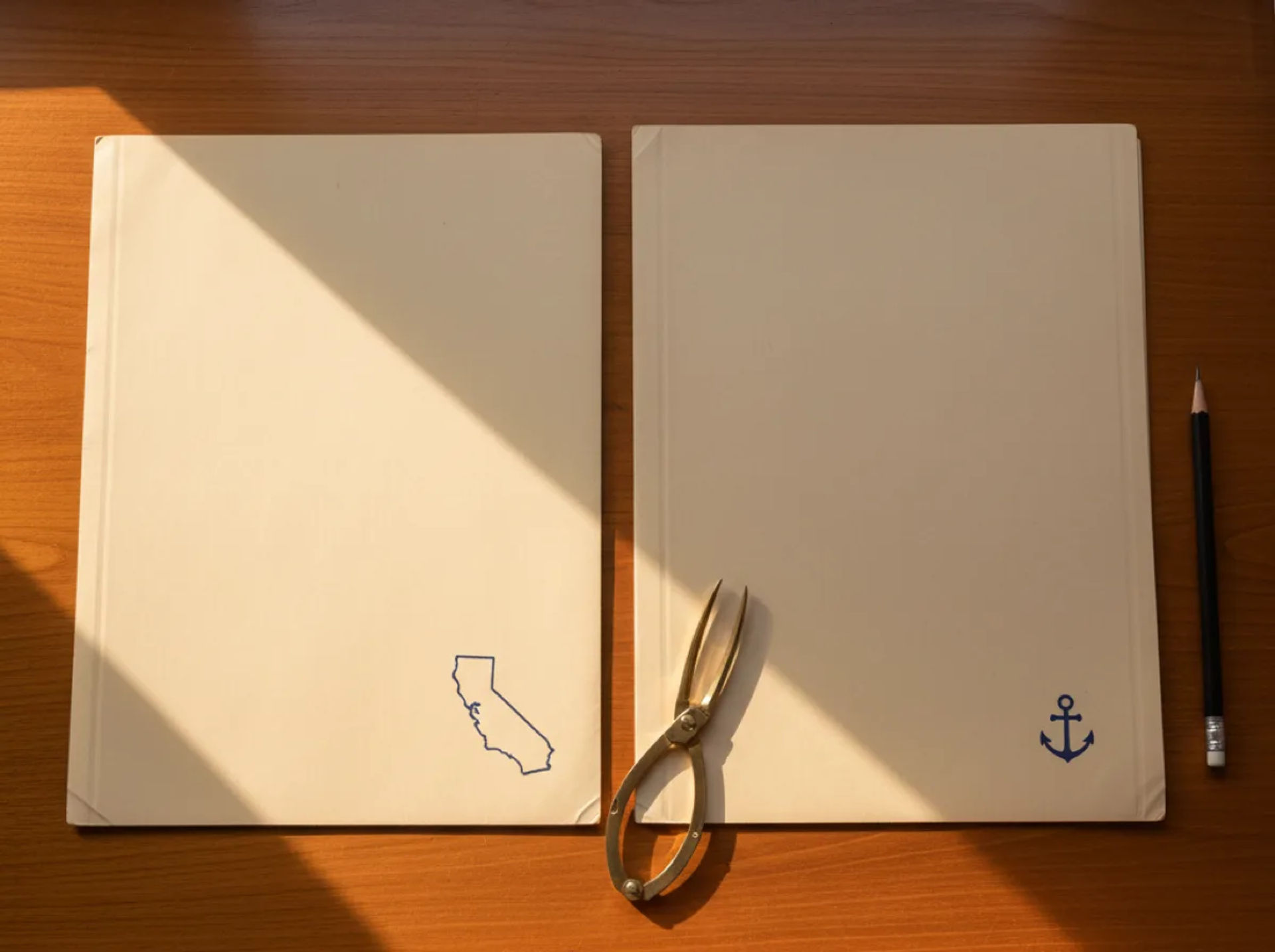
Going the other way takes a release from documentation and a new CF number. Sellers who pulled a boat out of documentation years ago and never finished the state side hold two stale documents and no valid record at all.
Tax follows the same split. On a documented vessel, California use tax goes to CDTFA rather than to a DMV counter; on a state-registered boat it is collected at registration. The rate follows where the vessel is moored, not the seller's address, and CDTFA sets the due date as the earlier of the first day of the month after it contacts you or the twelfth month after purchase. December versus January closings change who files what, and when — worth settling with the buyer before the deposit clears.
The Pre-Listing Paperwork Checklist
Print it and work down it. This is the list a broker runs before agreeing to list, and the one a buyer's broker requests within a week of an offer.
- Certificate of ownership or documentation, current and in the seller's exact legal name
- Registration card, if state-registered, with the CF number visible on the hull
- Bill of sale ready to sign, official number or HIN filled in
- Release recorded, or a payoff letter that survives to closing
- Hull identification number legible and in the twelve-character format
- Service records for engine, rig and recent yard work
- Signed authority if the seller is an LLC, trust or estate

A buyer holding this file before the survey has less room to reopen price later: the unknowns were removed early instead of defended at the end. Our brokerage team runs the same audit before agreeing to a listing date.
At Closing: What the Seller Signs and Files
Closing is short if the audit was done: sign the bill of sale, confirm funds and the lien release, hand over the title documents. Then comes the step owners forget: the Notice of Transfer and Release of Liability (REG 138) goes to DMV within five days of the sale, the window set by CVC §5602. File it online, and attach nothing — DMV does not retain attachments.
REG 138 does not remove your name by itself. That happens when the buyer transfers the boat into their own name, and until then you remain owner of record — which is why citations and moorage disputes find the previous owner. On a documented vessel, the equivalent protection is a recorded bill of sale and an application NVDC has actually received.
This is also where a brokerage earns its fee, as described in how Naos handles exposure and closing. A seller who runs the audit alone still gets a clean file; the difference is who chases the counterparties when one goes quiet.
FAQs
Do I need a title to sell a boat in California? Yes, but which one depends on the boat: a Certificate of Ownership if state-registered, a Certificate of Documentation with a recorded bill of sale if documented.
My boat is Coast Guard documented — do I also need California registration? No. A documented vessel is not registered by the state, and holding both creates the contradiction that stalls a closing.
My registration lapsed two cycles ago — does that block a sale? No, but it must be restored before transfer, and the 50 percent penalty is part of the cost of selling late.
Can I sell a boat that still has a loan? Yes, and many boats change hands that way. What cannot wait is the recorded release: a buyer's lender will not fund against an open lien.
My ex-spouse is still on the title — do both signatures matter? Yes. Every name on the certificate signs the transfer, and a missing signature cannot be worked around at the closing table.
How long does a Coast Guard documentation transfer take? Check the NVDC Case Processing Report rather than asking for an average. In the bulletin dated October 16, 2026, the recreational queue was working on filings from July 27, 2026.
Who pays the use tax? The buyer owes California use tax, collected by DMV at registration or paid to CDTFA on a documented boat. Who bears it is a contract term — settle it in the purchase agreement.
Start With the File, Not the Listing
A California boat sale stalls on documents more often than on price, and the seller controls nearly all of that risk. Pull the record, reconcile the names, chase the release, restore what lapsed. Sixty days out, a repair is cheap and a buyer is patient.
If you would rather have the file read before you commit to a listing date, that conversation is free — and the team behind it is small enough to answer directly.
Last reviewed: November 2026. Thresholds, fees and NVDC processing dates change; verify against the linked sources before relying on them for a specific transaction.