Every few weeks, a sailor sits across from us in Marina del Rey and says the same thing: "I want a boat that sails properly, and a boat the family will actually board." That tension is the whole story of choosing between Beneteau performance and cruising lines. The Oceanis range answers with volume, light, and comfort — a cockpit that becomes a salon, cabins people sleep well in, sail handling a couple can manage. The First range answers with a tauter, lighter hull, a deeper keel, and a rig that rewards the sailor who trims. Neither family is better; each answers different questions about how you sail, who comes aboard, how you feel at the helm. This guide compares both honestly, so you can match a new build to your plans.
The Oceanis Philosophy: Comfort as a Design Target
The Oceanis family — from the 30.1 up to the 52 — treats comfort as engineering, not decoration. Hulls are beamy and balanced, twin rudders give steady, forgiving steering, and the deck is arranged around the people aboard. The cockpit table turns the crew area into a salon at anchor, wide side decks make moving forward easy, and hatches flood the interior with light.
Sail handling follows the same logic. A self-tacking jib and a two-winch cockpit mean most tacks are a turn of the wheel, and the optional in-mast furling main lets you shorten or stow sail without leaving the coachroof. You sail short-handed, guests move safely, weekends feel like holidays. That beats raw knots when the crew includes children or a partner who is keen but not obsessed.
The First Range: Built Around the Sailor Who Trims
First yachts come from a different brief. The racing pedigree runs deep — the original First 30 was the Tour de France à la Voile's official boat for three seasons, and today's First 30, 36, 44, and 60 carry that lineage per the official Beneteau First overview. Hulls are light but taut, keels run deeper with ballast low in a bulb, and fractional rigs reward precise trim. The helms sit where you feel the boat load up in a puff, and lifting-keel options open anchorages a deep fin would never allow.
The cabin is livable for weekends and longer, but the priorities show: this is a boat for owners who come home and quote the wind. If that sounds like you, our history of the Beneteau First is the place to start.
At the Helm and Below Deck: Where the Difference Shows
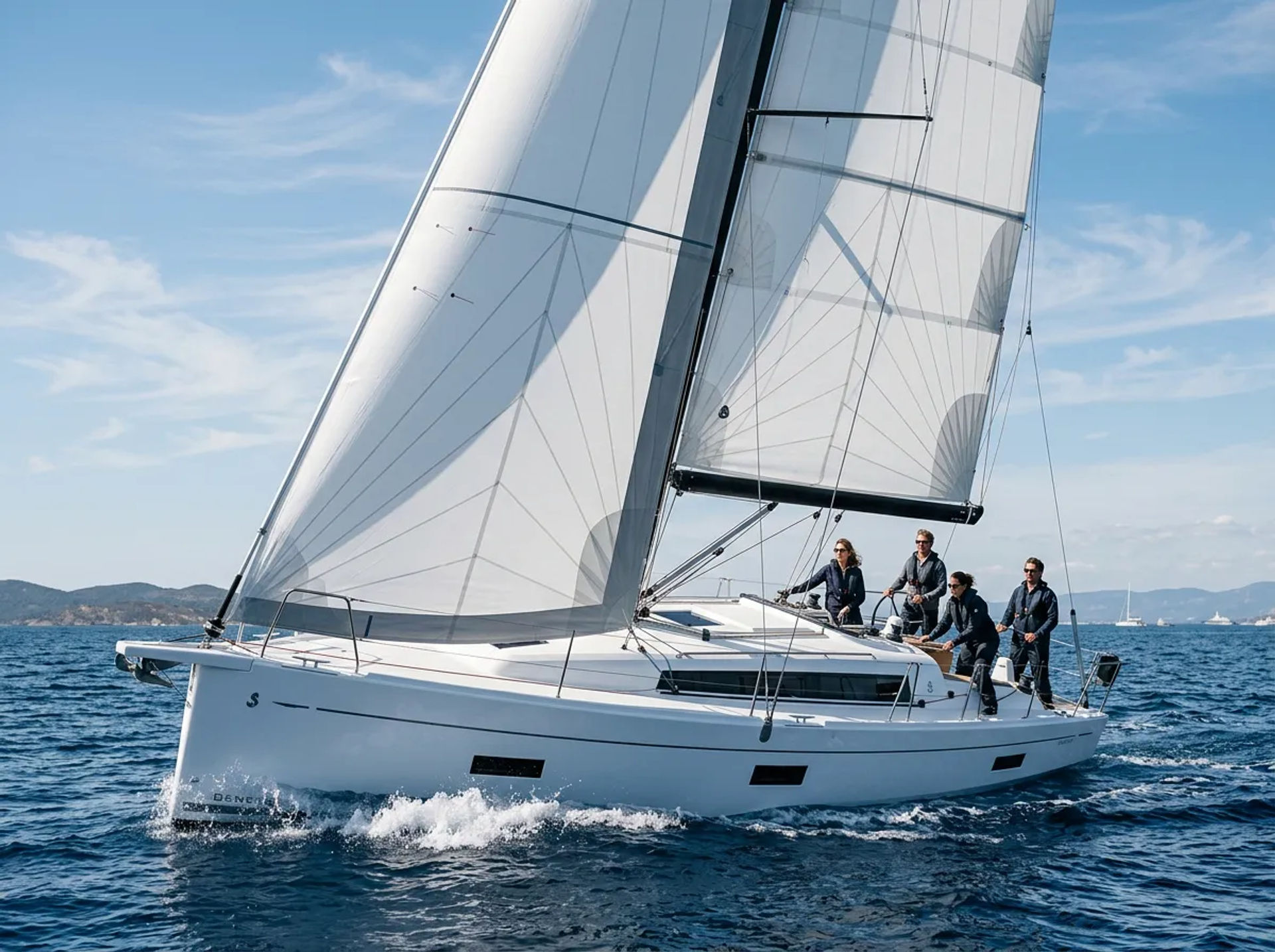
The difference appears within minutes at the helm. On an Oceanis, steering feels balanced and unhurried; in a gust the boat heels gently and the twin rudders keep their bite. On a First, you feel every pressure change earlier — the boat loads up and asks you to respond. Neither is unsafe; they are different conversations with the water.
Below deck the gap widens. Even the smallest Oceanis offers standing headroom, a proper galley, and stowage for real provisioning; larger models give three-cabin layouts that host well. The First 30 is an honest weekender, while the First 44 and 60 balance speed with interiors for genuine passages. In short: the Oceanis is a home that sails beautifully; the First is a sailing machine that sleeps four to six well.
The Power Side of the Beneteau Range
If your plan includes long motoring stretches or guests who prefer the salon to the helm, the sailboats are not the whole story. The Antares line extends the same easy-handling philosophy to weekend cruising under power; the Gran Turismo range is the performance answer — express-cruiser styling for a confident skipper. Either way, one service network and one dealer.
Which New Build Matches Your Sailing Plan?
Match the family to the majority of your sailing, not the dream trip.
- Weekend coastal cruising from Marina del Rey or Redondo: an Oceanis 34.1 or 37.1 with a self-tacking jib is hard to beat — short-handed comfort, all season.
- Catalina crossings and two- to three-day trips: an Oceanis 40.1 or 42 makes the 26-mile hop feel easy; a First 36 gets you there faster and more involved.
- Club racing and a serious Wednesday-night fleet: the First 30 or 36 — you will crew with people who enjoy trimming.
- Longer horizons — Channel Islands passages, a coastal delivery, distant anchorages: the Oceanis 47 and 52 are long-distance cruisers; the First 60 brings pace to the same mission.
Most owners pick the family that covers their average month, not their best weekend. Race three times a year and cruise the rest? The First 36 still weekends well, and you will enjoy every race. Family first, racing twice a season? An Oceanis with the Performance sail package adds pace without losing the cockpit table. Browse current Beneteau availability before committing; hulls in person beat any brochure.
The Options That Change the Experience More Than the Hull
The options that change daily life most are in-mast furling for the main, a self-tacking jib, an autopilot, and an electric windlass: together they let one or two people handle a 37-footer entirely from the cockpit. Spend the budget there before cosmetic extras.
Each repays attention. In-mast furling means you reef and stow from the cockpit, so you sail more often in shoulder-season breeze. A self-tacking jib, standard on most Oceanis models, turns every tack into a wheel turn. An autopilot earns its place on any Catalina crossing. And an electric windlass is the difference between anchoring often and anchoring reluctantly.
New Build or Recent Pre-Owned?
A new build is yours from the first launch: full warranty coverage, a spec you chose with a dealer who knows the line, and no previous owner's habits to unbuy. Ordering also fixes the small things — sail inventory, electrical upgrades, furling — before the hull touches water. The NMMA U.S. Recreational Boating Statistical Abstract tracks both retail and pre-owned markets; the pattern holds: new buyers trade specification control for warranty and certainty.
The recent pre-owned path deserves a fair hearing. A two- to five-year-old Beneteau is available immediately, priced below the equivalent build, and a well-maintained example is a strong buy: you give up configuration choice and factory warranty years, and you gain a boat to sail next weekend. The BoatUS Boat Buyers Guide covers both routes, and our new versus brokerage guide compares timing and specification control in detail. For what is docked today, the full inventory page is the honest starting point.
What a Dealer Actually Adds to the Order
A good dealer earns the margin in three places: the sea trial, the order, and commissioning day. That is why we always say test sail before you configure — an hour on the actual hull tells you more about balance than any brochure.
Ordering is the second job: we manage the build slot, translate your priorities into the right option list, and keep you informed as the hull moves through the yard. Commissioning is where the boat becomes yours — rig tuned, systems proven, electronics configured, full walkthrough before delivery. Our team has represented Beneteau for fifteen years; the team page shows who handles it, and they stay with you for warranty service and, later, when you grow or trade. If it has been a while since you sailed, our boating lessons run out of Marina del Rey with ASA-certified instructors — a refresher before delivery is worth any option box.

FAQs
Can a couple handle a First day to day?
Yes. The modern First range was designed around short-handed handling — self-tacking jib and electric winch options — so a couple can race-cruise without a rail crew. The Oceanis remains even lighter on crew, but "First" no longer means "crew required."
Which line is better for Catalina crossings?
Both cross comfortably; the question is what you want from the trip. Choose the Oceanis when a relaxed crew matters — beam and twin rudders make the 26-mile run feel easy. Choose the First when pace and helm feel are the point. If crew comfort decides your season, err toward the Oceanis.
Is in-mast furling worth giving up sail shape?
For most cruising owners, yes: you will reef and stow far more often, and the small weight aloft is imperceptible at cruising speeds. Race-oriented owners usually prefer a full-batten main for shape. Think about how often you shorten sail.
How much should draft matter to my choice?
Draft decides which anchorages and slips work for you — a real constraint around marina berths and shallow Catalina coves. Beneteau offers shoal-draft and lifting-keel options across both lines; discuss your berth and anchorages before settling the spec.
How long does a new Beneteau build take?
There is no fixed published timeline; it depends on the model, the build slot, and your spec. Ask your dealer for the slot position at order time — an active allocation usually shows exactly where your hull lands.
Can I trade my current boat into a new build?
Yes — and one of the smoothest paths. As both broker and dealer, we value your current boat, market it while your new hull is on order, and structure the trade so you are not carrying two boats through a season.
The Bottom Line
Choose the family that covers your average month: Oceanis when comfort, volume, and short-handed ease lead; First when pace and response are the point; Antares or Gran Turismo when your plan runs on power. Spend the option budget on furling, autopilot, and anchoring before cosmetics; compare a build slot against recent pre-owned availability. The next step is a real conversation: get in touch, test sail the hulls, and let a dealer specialist walk you through slots and commissioning. Fifteen years selling Beneteau in Southern California tells us the right hull announces itself on the water, in about an hour.
Last reviewed: October 2026.