You face two very different transactions: a factory order for a new Beneteau or Lagoon arriving in your marina months from now, and a brokerage boat that already floats in a nearby marina, ready for a sea trial this week. Both paths are realistic for Southern California buyers, and the new vs brokerage decision is not about which is better — it is about which matches your timeline, budget, and tolerance for uncertainty. As a Beneteau Group dealer that also runs a full brokerage desk, we sit on both sides of the comparison and can show you the trade-offs honestly — including the ones that hurt late. Start with what exists today in our Beneteau inventory and Lagoon listings, then work through the questions below.
The Two Paths Are Not the Same Purchase
A factory order is a process; a brokerage boat is a product. Order new and you select the model, options, and delivery window, then wait through production and commissioning. Buy brokerage and the boat is already built and moored nearby — walk its decks, start its engines, negotiate on something that exists.
The pricing logic differs too. A new build starts from the model's list price plus your chosen options, with the factory warranty included. A brokerage listing is priced against what comparable boats actually sell for — which is why similar Beneteaus and Lagoons can sit at very different numbers depending on condition, equipment, and listing time.
New: What a Factory Order Actually Buys You
Ordering new is the only path where you control the specification end to end: engine package, sail plan or propulsion, interior wood, electronics, deck layout. On a Lagoon, that means choosing your owner's version before the hull is laid up; on a Beneteau, ordering the rig and keel your sailing needs instead of a previous owner's choices.
You accept two real costs. The first is the wait: the boat follows the factory's production schedule, with slots moving through the yard in sequence — our new arrival planning guide covers that process. The second is depreciation: the gap between what you paid and what the market would pay is widest in the first seasons. Keep the boat a decade and the curve barely matters; trade in three seasons and it is the whole story.
The factory warranty is the quiet advantage most buyers underweight: structure, systems, and gear are covered from delivery. Through a dealer you also get commissioning by a team that delivers these boats regularly, plus a real sea trial before you sign. For new-boat demand context, the NMMA Statistical Abstract tracks retail sales; start your spec work on the current Beneteau range and bring the shortlist to us.
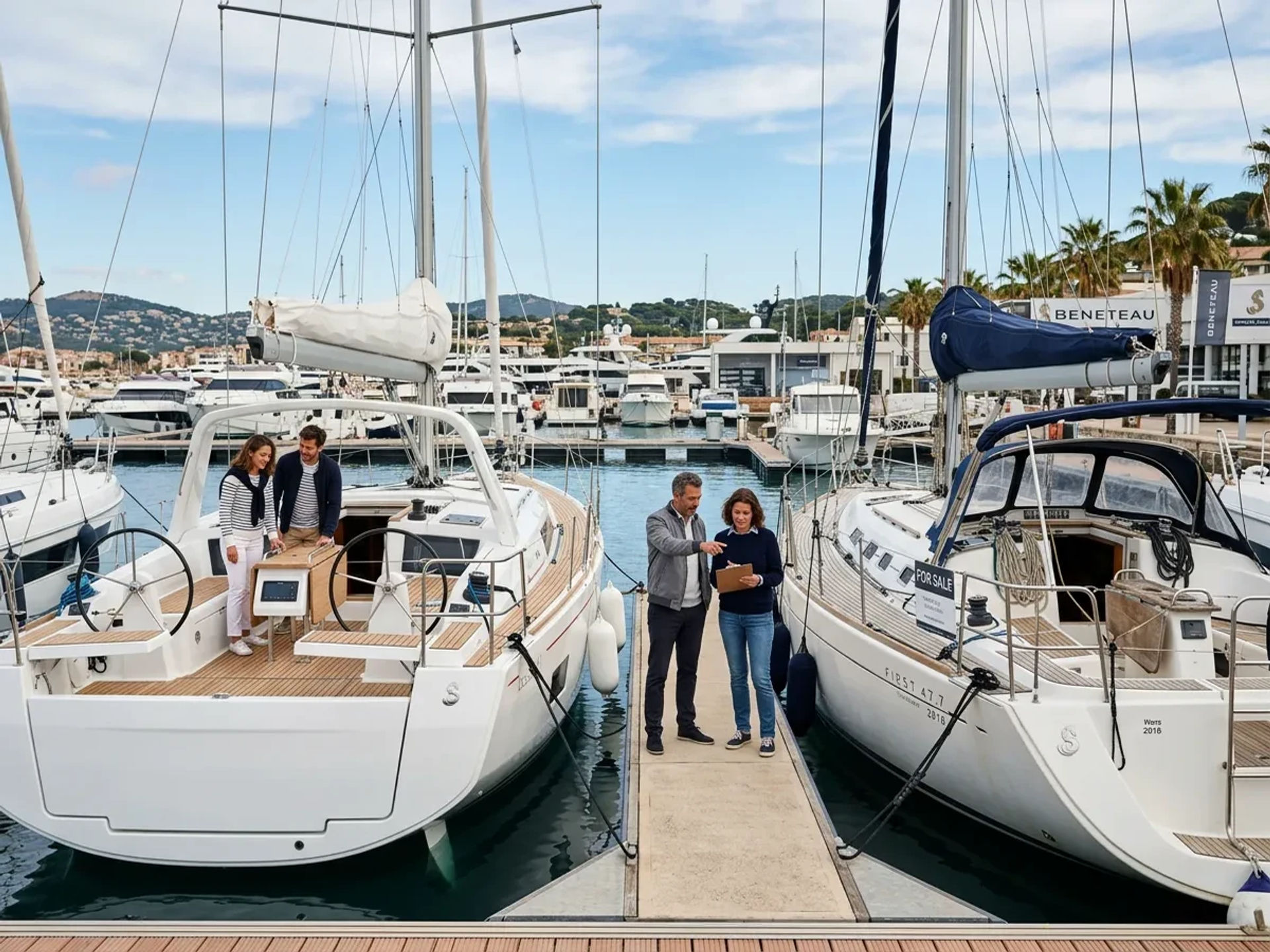
Brokerage: Buying the Boat That Already Exists
Brokerage inverts the trade-off. Available now — you can be sailing this month instead of planning around a build slot. The price sits below an equivalent new configuration because the first owner has already absorbed the initial depreciation, and that gap is widest on well-kept boats a few seasons old. In practice: a better-equipped boat for the same budget, or the same boat for less.
Recent brokerage Beneteaus and Lagoons also arrive with options already installed and paid for: air conditioning, generator, upgraded sails, solar, bow thruster, tender systems. Adding those to a factory order is where new-boat budgets quietly grow. On a pre-owned boat you see and test them before pricing them into the offer — the catch is that "installed and working" needs verifying, which is where engine hours and the survey take over.
The Trade-Offs, Side by Side
On the new side you take an exact configuration, a full factory warranty from day one, a delivery timeline anchored to production, and a price built from list plus options — knowing the value softens fastest in the first seasons. You wait and pay more for a boat never abused, neglected, or modified to someone else's taste. For long-term owners with their own spec, it is usually worth it.
On the brokerage side you get a boat you can inspect and buy now, priced below its new equivalent, with equipment already fitted and an ownership history you can audit. The unknowns are condition and usage: engine care, maintenance habits, deferred work. A recent, well-maintained boat bought with eyes open is often the better financial decision — the better certainty decision only when the history checks out.
Five Questions That Decide Faster Than Price
Before comparing numbers, answer five questions — they disqualify options faster than any spreadsheet. What will the boat actually do: day sailing, long cruising, charter, racing? When do you want to be on the water? What is your all-in budget, including slip, insurance, and first-season extras? How much does the wait bother you? How important is warranty protection?
The profile writes itself. A defined season, a planned cruise, or a charter contract collapses the decision toward what is available and proven — brokerage. A decade of family cruising and a flexible timeline make the wait for a factory-spec build stop being a cost. A fixed budget argues for brokerage first, new only when available boats fail inspection.
The History Test: Engines, Maintenance, and the Survey
Brokerage boats live or die on paperwork. Request engine and generator hour logs, service records, and major-work receipts, and read them like a logbook: regularity matters more than volume. A high-hour boat with flawless, dated maintenance beats a low-hour boat with gaps in its records. Ask when the bottom, rigging, and electronics were last updated.
Then follow our survey and sea trial guide: a surveyor inspects structure, systems, and safety gear against ABYC standards, and the sea trial confirms engines and steering under load. On a recent boat it separates a bargain from a problem — budget for it and condition your offer on it.
Trade-In: The Third Path Most Buyers Overlook
There is a third path: use the equity in your current boat as the deposit on the next one. Dealers routinely accept a trade-in against a new order and, depending on marketability, against a brokerage purchase too. The dealer values your boat, credits the equity, and sells your old boat while you wait — one transaction, one set of paperwork.
It suits owners moving up the ranges — Oceanis to Lagoon as the family grows, First to a larger Oceanis. Trade-in value lands where the market sets it, but a well-kept Beneteau or Lagoon holds its ground because dealer networks, parts availability, and steady demand keep resale active. Equity parked in a boat you no longer need? Get a working valuation before you commit.
Matching the Path to Your Portfolio
The right path depends on where you are in boating life — match it to your situation, not the deal of the month.
First boat, first season: buy recent brokerage. You learn what you want faster on a boat you can inspect, the entry price is lower, and the survey protects you. Our family-cruising picks across new and brokerage show how the same budget behaves on each side.
Growing family, defined plan: a factory order funded by trade-in. The cabin layout, generator, air conditioning, and davits you will live with for a decade are worth the wait, and your current boat's equity covers the deposit — where a new Lagoon or Beneteau earns its price.
Seasoned owner with equity: order new and let the dealer sell the old boat. You know your spec, you know the brands, and depreciation on a keeper is a footnote, not a headline; the relationship you have built collects at trade time.
Timing-driven buyer — charter, seasonal use, a fixed departure: brokerage wins. Availability decides, so buy the most recent, best-documented boat that passes survey, budgeting for missing equipment. Checking end-of-year timing? The buy now versus wait framework maps it.

The Short Answer
Buy new when you want an exact configuration, warranty coverage, and a boat that starts life with you — and can wait for the build. Buy brokerage when availability, price, and installed equipment outweigh specification control. Verify history with a survey; use trade-in equity to fund either path.
FAQs
Is a new boat the better financial choice?
Rarely on paper. The first owner absorbs the steepest depreciation, so a recent brokerage boat almost always costs less for equivalent equipment. New wins on specification certainty and warranty, not price. Buy new for control and coverage; buy brokerage when value matters most.
How long does a new Beneteau or Lagoon take to arrive?
It depends on the model, the factory schedule, and when a production slot opens — there is no honest single number. The build follows the yard's sequence: hull, systems, commissioning. Your dealer can tell you where the next slot sits; our arrival planning guide covers the process and what to ask before reserving.
What should I inspect before buying a brokerage boat?
Engine and generator hours, service records, receipts, then the survey and sea trial. Look for regularity rather than low hours alone, check the last dates of bottom, rigging, and electronics work, and condition your offer on a clean survey.
Can I trade my current boat in on a new order?
Yes. The dealer values your boat, credits the equity against the purchase, and handles the sale while you wait. The same structure can apply to a brokerage purchase when the boat fits the dealer's market. Bring records — the valuation is only as good as your documentation.
Do I lose the dealer relationship if I buy brokerage?
No. Through a dealer's brokerage desk, the same team commissions, services, and supports the boat, and that history counts when you trade up — a quiet advantage of buying pre-owned through a Beneteau Group dealer rather than a private party.
Which path suits a first-time buyer?
Recent brokerage, generally. You learn your preferences faster on a boat you can inspect, the entry price is lower, and the survey protects you. Order new on the second purchase, when you know your specification well enough to wait.
Deciding in Practice
New and brokerage answer different questions; they are not rival versions of the same one. New buys specification control, full warranty, and a boat that starts its life with you, at the cost of the wait and first-owner depreciation. Brokerage buys availability, installed equipment, and a lower price, at the cost of trusting a history you must verify. Run both sides: check what sits in current inventory, confirm where the next build slot sits, and price the equity you bring. Then bring your numbers to our team — we structure either path and tell you honestly which fits.
Last reviewed: October 2026.